AI in Procurement: A Guide for Smarter, Faster Sourcing
authors are vetted experts in their fields and write on topics in which they are extremely knowledgeable. All of our content is peer reviewed and validated by world-class professionals.


Throughout my 25 years leading global supply chain and procurement organizations, I have watched the procurement function become increasingly defined by a costly, reactive cycle. Most teams spend far too much time managing the immediate fallout of supplier delays, freight spikes, weather anomalies, and sudden pricing shifts. When a macroeconomic disruption occurs on the other side of the world, it forces organizations to quickly scramble and rethink sourcing decisions that looked perfectly stable only days prior. Unfortunately, by the time a team identifies these vulnerabilities through manual tracking, operations are already absorbing the financial and operational impact.
That’s why I’ve come to believe the biggest advantage AI brings to procurement is the ability to be proactive instead of reactive. More and more procurement leaders are reaching the same conclusion as supply chain disruptions become harder and more expensive to manage once operations are already affected. According to Deloitte’s 2025 Global Chief Procurement Officer Survey, digital transformation and AI adoption remain top priorities for organizations focused on resilience, cost management, and operational agility.
What’s striking to me is how quickly AI becomes part of the way people think once they start using it regularly. I use it constantly now, not just professionally but in everyday life too. Once procurement teams realize how quickly AI can automate tasks like surfacing information and accelerating sourcing analysis, they begin to work differently.
In this article, I’ll explore how AI in procurement is changing sourcing workflows, where organizations are seeing the biggest operational gains, and what procurement leaders should consider as AI adoption accelerates.
What Is AI in Procurement?
When most people hear “AI in procurement,” they immediately think about automation. But in my experience, the bigger shift is how quickly procurement teams can now process information and act on it.
A sourcing event that once required weeks of back-and-forth communication can now move faster with AI supporting the process. Procurement teams are using AI to review contracts, evaluate supplier bids, monitor disruptions, draft RFPs, and identify sourcing risks long before those problems affect operations.
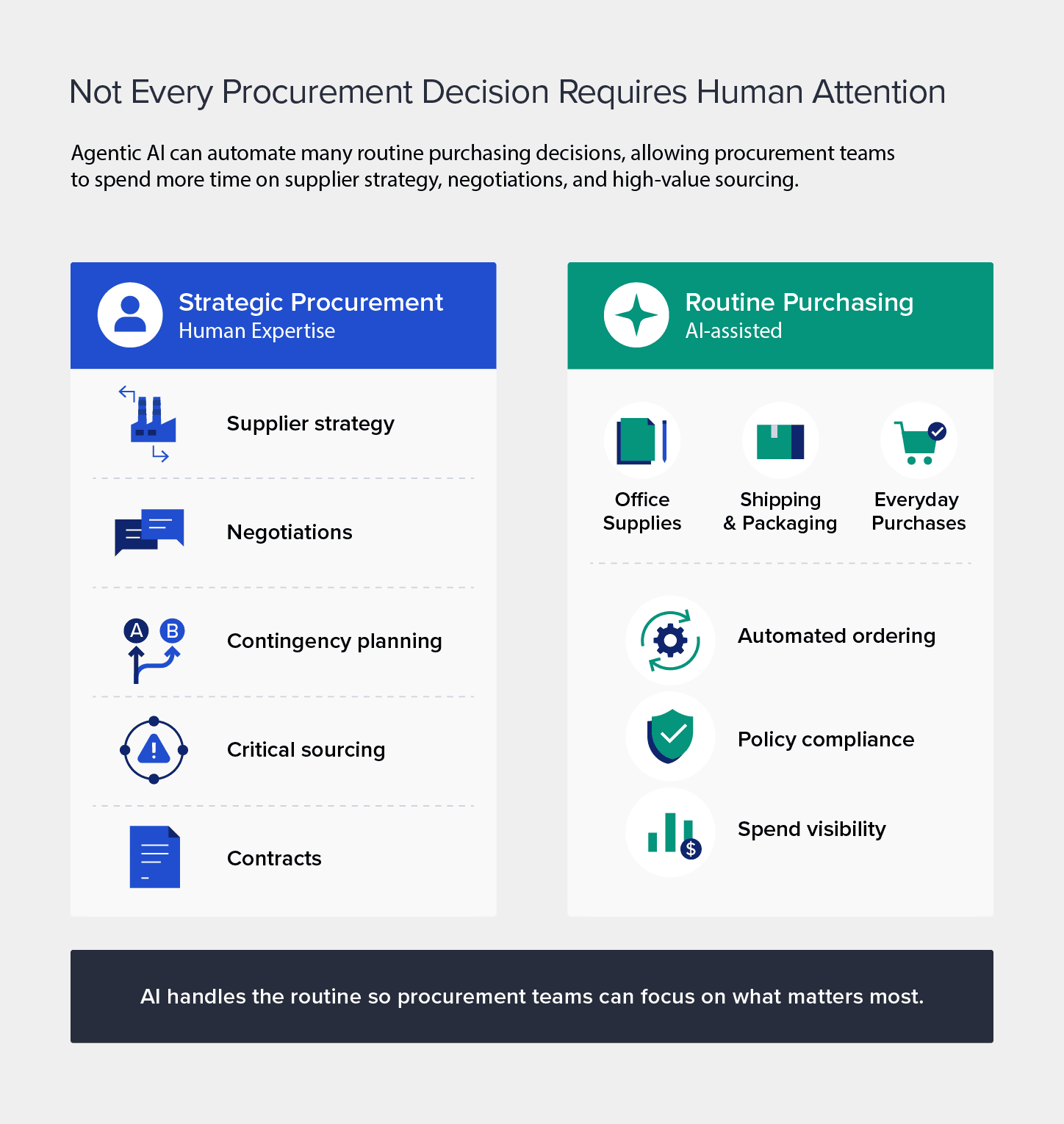
A few different types of AI are driving that change. Machine learning models can continuously improve as they absorb more purchasing and supplier data over time. Generative AI tools are helping procurement teams accelerate administrative work that used to take hours. Agentic AI platforms are also moving beyond simply answering questions and into actually executing procurement tasks within predefined rules. Earlier AI systems mostly functioned like assistants: You asked a question, and the platform returned information. Rather than stopping at analysis, agentic AI systems can now act within predefined boundaries. For example, a procurement team might allow an AI system to source routine purchases from approved suppliers, compare pricing against established thresholds, and recommend the best option without requiring a buyer to manually evaluate every transaction.
Why Procurement Teams Need AI Now
The pace of disruption across global supply chains has permanently changed procurement. Teams are constantly responding to changing freight costs, supplier delays, weather disruptions, shifting tariffs, geopolitical instability, and fluctuating demand patterns. Without AI, procurement teams often end up reacting after problems have already impacted operations.
That reactive cycle becomes expensive fast. In 2025 alone, General Motors said its AI-powered supply chain monitoring tools helped the company avoid roughly 75 production stoppages tied to disruptions like hurricanes and material shortages. Procurement teams no longer have the luxury of waiting for problems to fully materialize before responding.
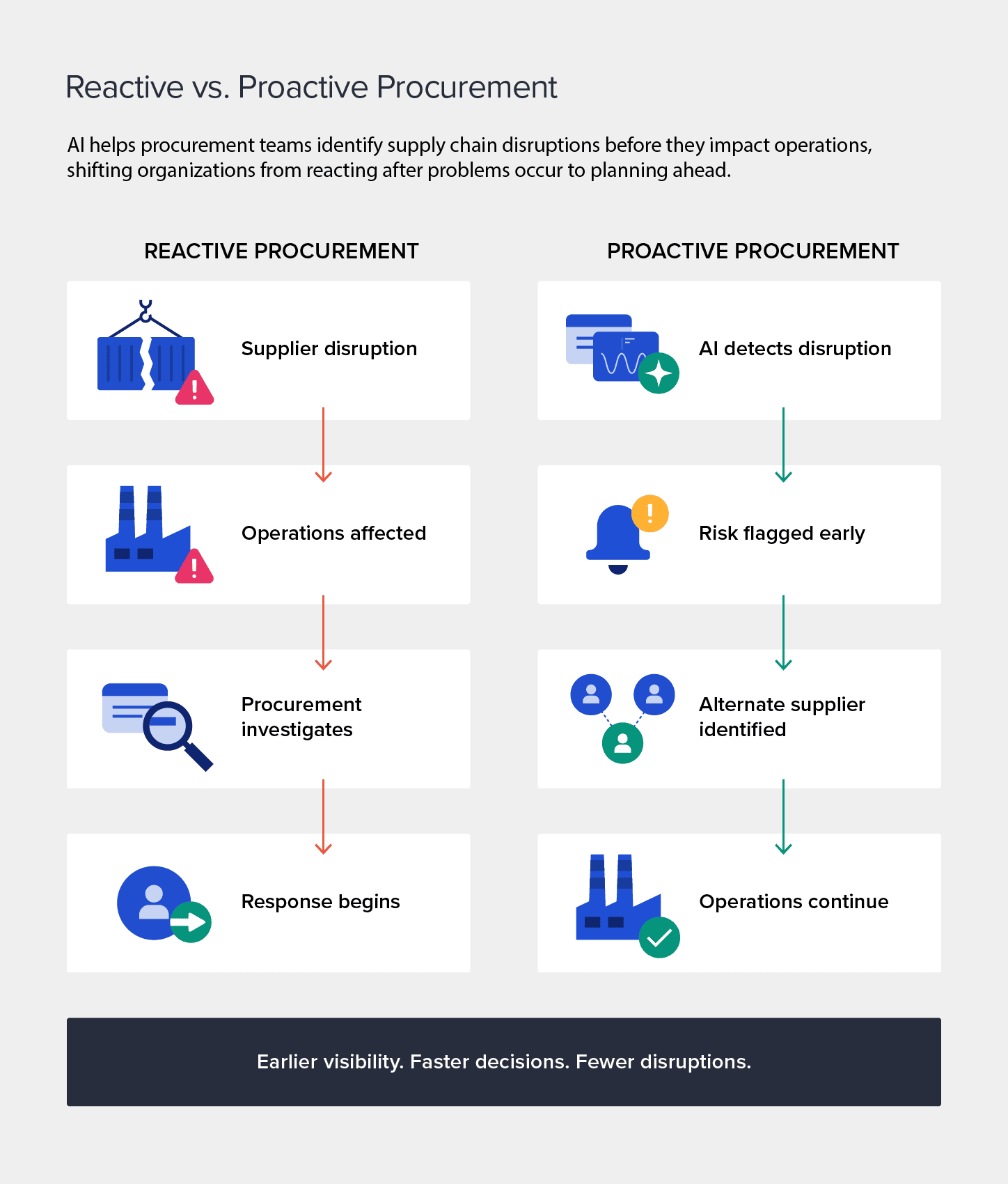
I’ve seen situations where severe weather disrupted supplier production or transportation routes with very little warning. In the past, procurement teams might not have discovered the issue until materials failed to arrive on schedule. AI changes that by identifying risks earlier and allowing teams to prepare contingency plans before disruptions escalate.
If there’s bad weather taking place next week, AI can start helping the procurement team plan now, I often tell people. Maybe that supplier loses power or transportation routes shut down. Now you’re giving procurement teams visibility into the future rather than always reacting after the fact.
That same logic applies to factors such as commodity volatility and transportation bottlenecks. AI in sourcing helps procurement organizations continuously monitor supplier conditions and evaluate alternative sourcing strategies more quickly than traditional workflows allow.
For procurement leaders, that speed increasingly matters just as much as cost savings.
The High Cost of Poor Procurement Decisions
Many procurement inefficiencies accumulate quietly over time. Maverick spend, missed rebates, supplier delays, stockouts, freight overruns, and poor vendor oversight may seem manageable individually, but collectively they can create significant financial and operational pressure.
One area I believe organizations still underestimate is supplier due diligence. Large customers and regulators increasingly expect organizations to understand exactly who they are sourcing from and whether vendors comply with sustainability and regulatory requirements.
If a company fails to properly vet a supplier, the consequences can escalate quickly. I’ve seen situations where procurement teams thought they had a transparent supplier relationship only to discover compliance concerns much later during a customer audit. Something as serious as prohibited labor practices can suddenly become a reputational and financial problem for the entire business, even if procurement teams weren’t initially aware of the issue.
But AI can continuously monitor supplier risk in the background without teams having to chase information. Now, they can identify potential compliance issues or supplier performance concerns before contracts are finalized rather than discovering them after operations are already affected.
I’ve seen a similar shift happen during sourcing events and RFP creation. Before AI became widely available, procurement teams spent enormous amounts of time simply trying to keep sourcing documentation aligned. Specifications changed constantly, and suppliers updated lead times mid-process. Spreadsheets circulated through multiple departments while procurement teams reconciled revisions and tracked down missing information on their own. At scale, that administrative burden became incredibly difficult to manage efficiently.
With AI, that process can move dramatically faster. I’ve seen sourcing projects that once required a month or more of preparation compressed into a fraction of that time because AI can handle large portions of the repetitive administrative work behind the scenes.
That doesn’t eliminate the need for procurement professionals. If anything, it gives teams more room to focus on the parts of procurement that actually create strategic value: supplier relationships, negotiations, contingency planning, and long-term sourcing decisions.
Data Foundations for AI Adoption
One of the biggest misconceptions about AI in procurement is that organizations can simply plug in a new tool and immediately start generating value. In reality, AI systems are only as effective as the data supporting them. If supplier records are inconsistent or ERP systems contain inaccurate information, AI outputs will be unreliable as well.
I’ve seen organizations struggle with something as basic as inconsistent supplier naming conventions across facilities. If vendor data isn’t standardized properly, procurement teams can’t accurately evaluate supplier performance or purchasing trends across the business.
Before organizations scale AI adoption, they need:
- Clean supplier data.
- Standardized purchasing records.
- Centralized procurement visibility.
- Consistent part and commodity classifications.
- Integrated operational systems.
Without those foundations, even sophisticated AI platforms will struggle to deliver reliable insights.
Integration Architecture Matters
AI becomes much more useful when it can access information spanning the systems procurement teams already use every day. Purchasing platforms, inventory systems, supplier portals, freight data, and ERP environments all contain pieces of the larger operational picture. When those systems don’t communicate well with one another, procurement teams often end up stitching information together manually just to understand what’s happening across the supply chain.
That’s where stronger integrations can make a major difference. AI can continuously monitor sourcing activity in real time and surface issues much earlier. A freight delay, a supplier disruption, or an unexpected inventory issue becomes easier to spot before it creates larger operational problems downstream.
At the same time, I don’t think organizations should assume they need a perfectly integrated enterprise AI ecosystem before getting started. Many companies are intimidated by the infrastructure side of AI adoption and assume they need massive technology investments upfront. In reality, modern AI tools are already incredibly powerful on their own.
Even without direct ERP integration, procurement teams can still use platforms like ChatGPT or Gemini to accelerate sourcing research, compare suppliers, summarize contracts, or analyze procurement data faster than they could without it. If budget constraints exist, I wouldn’t let that stop adoption entirely. There’s still meaningful value organizations can capture before committing to larger infrastructure projects.
Streamlining RFPs and Sourcing Workflows
AI is already changing procurement during sourcing events, especially when teams are building RFPs. A request for proposal is where a sourcing strategy begins to take shape. What do we need? Who can supply it? What happens if lead times shift? What will the supplier commit to, and what risk are we taking on if they can’t deliver?
That process can get messy fast. Specifications change. Pricing shifts. Suppliers update lead times. Internal teams disagree on what should be included. Before long, procurement is reconciling multiple versions of the same document while trying to keep the sourcing timeline moving.
Generative AI helps reduce some of the administrative burden on procurement teams. Instead of spending hours reviewing every supplier response or rebuilding sourcing documents every time requirements shift, teams can move through the early stages of the process quickly and focus their attention where it matters most: supplier strategy, negotiations, and risk.
Supplier Risk and Continuity Intelligence
Supplier risk management is another area where AI delivers significant value, a factor that matters because modern procurement disruptions rarely happen in isolation. A transportation issue can quickly turn into a production problem. A regional power outage can suddenly force procurement teams to identify alternate suppliers halfway across the world.
I’ve seen how valuable monitoring can become in real-world manufacturing environments. While working with Oakley sunglasses, for example, we managed a highly complex global sourcing operation involving commodities sourced from multiple countries and delivered to a single manufacturing facility in California. With tens of thousands of parts supporting production schedules, even a small disruption could quickly create operational problems.
At one point, power outages affected suppliers in Brazil, forcing us to pivot rapidly to backup suppliers in China to avoid production delays. AI-supported insight made it much easier to identify the disruption early and accelerate alternate sourcing decisions before operations were heavily impacted.
That’s the difference between reactive procurement and proactive procurement. The goal is to respond while there’s still time to maneuver.
Tactical Purchasing Automation
Procurement teams still lose a surprising amount of time on routine purchasing. Somebody has to order the pencils. Somebody has to source the toilet paper. Somebody still has to compare pricing on low-cost operational items that aren’t strategically important but still keep the business running.
Agentic AI is starting to absorb more of that tactical purchasing work. The system can handle much of the process on its own: It identifies suppliers. It checks pricing against existing rules. It recommends the best option based on cost and timing. More importantly, it gives procurement teams room to focus on the sourcing decisions that actually move the business.
ESG, Supplier Diversity, and Compliance
Environmental, social, and governance (ESG) requirements are becoming a much larger part of procurement strategy, especially for organizations working with enterprise customers that maintain strict sourcing and compliance standards.
In many companies, procurement teams are now expected to understand far more about their suppliers than just pricing and delivery performance. They may need transparency around labor practices. They may need to track sustainability commitments or document supplier diversity participation for customers and regulators.
That type of oversight becomes difficult to manage manually across large supplier networks. AI helps by continuously monitoring supplier information in the background and flagging potential compliance concerns much earlier. With it, procurement teams can identify risks while sourcing decisions are still being made.
I expect that kind of monitoring will become increasingly important as procurement reporting requirements continue expanding.
Measuring Success With Procurement AI
One mistake I see organizations make is assuming AI success is measured only by how much labor it eliminates. In procurement, the impact is usually much broader than that. One month, AI might help a procurement team catch a supplier issue early enough to avoid a production delay. Somewhere else, the value might come from compressing an RFP timeline that used to drag on for weeks. In other cases, it’s simply giving procurement leaders enough context to make faster decisions when conditions suddenly change.
At Oakley, for example, we managed thousands of components flowing into a single manufacturing operation from suppliers around the world. In that kind of environment, even a small delay can quickly ripple through production schedules. Metrics matter because they help procurement teams understand whether AI is actually improving responsiveness and operational stability.
The metrics I typically focus on include:
- Landed cost.
- Purchase price variance.
- Freight cost performance.
- Supplier on-time delivery rates.
- Supplier quality performance.
- Sourcing cycle time.
- Shipment accuracy.
- Inventory disruptions.
- Supplier scorecard performance.
These help procurement teams determine whether AI initiatives are improving performance in measurable ways. But procurement leaders should also recognize that AI adoption isn’t solely about cost reduction. In many cases, the greatest value comes from improving agility and reducing operational risk exposure.
Keeping Humans in the Loop
Despite how advanced AI systems are becoming, I don’t believe procurement organizations should remove human oversight from sourcing decisions entirely. AI is still a tool. It’s incredibly powerful, but procurement professionals remain responsible for making the actual strategic decisions.
I also think organizations sometimes underestimate how important creativity and critical thinking are in an AI-enabled environment. People who use AI effectively start thinking differently about how to solve procurement problems.
That’s something I’ve noticed in my own work too. Once people become comfortable using AI regularly, they start asking better questions. They start exploring scenarios they might not have considered before. The technology changes how quickly information moves, but it also changes how procurement professionals approach decision-making in the first place.
In my experience, the biggest limitation with AI usually isn’t the technology itself, but whether teams understand how to apply it effectively. The companies that gain the most from AI won’t necessarily be the ones with the flashiest tools. They’ll be the ones who figure out how to combine procurement experience, operational judgment, and faster access to information before competitors do.
The Future of AI in Procurement
A few years ago, if a procurement team needed to evaluate new suppliers, compare pricing, or respond to a disruption halfway across the world, somebody had to stop what they were doing and go hunt for the information manually. That was just part of the job.
Now, procurement teams are starting to operate differently because information moves differently. Questions that once took hours to answer can be resolved in minutes. Supplier risks surface earlier. Sourcing options become easier to evaluate. Procurement professionals spend less time digging and more time thinking.
I’ve noticed that shift in my own work too. Once people start using AI regularly, they stop approaching procurement the same way. They begin thinking ahead instead of constantly reacting. They start asking bigger questions because they finally have enough space to focus on them.
This shifts the entire paradigm from a reactive back-office function to a predictive driver of corporate resilience. For decades, procurement has been forced to manage supply chain disruptions retrospectively. AI fundamentally alters the decision-making timeline, granting leadership the clarity to evaluate alternative sourcing strategies and act before a disruption hits the bottom line. In a global market that shifts by the hour, moving from a reactive posture to proactive operational agility is a definitive competitive advantage.
